
“Teamwork makes the dream work” is probably my most hated phrase. A fluffy slogan teachers loved to slap on group assignments, usually just before sticking you with the kid who ghosted the whole semester. And the worst part? We were told this mess was preparing us for the “real world.”
I even had a former boss once tell me, “You can’t choose who you work with.”
But… why not?
Seriously. Why shouldn’t I choose who I work with? Why would I leave the most important part of building something—my team—to chance, default hierarchy, or HR roulette?
Throwing a group of people into a Slack channel and calling it a “team” doesn’t make it a team. It makes it a shared inbox.
The Real Deal: It’s Not Teamwork, It’s Dreamwork
The phrase “teamwork makes the dream work” actually originated to describe the efficiency of dividing tasks—each person doing what they’re good at, not just smiling and suffering through forced synergy. Somewhere along the line, we twisted that into “you must work with anyone and everyone” in the name of teamwork. And that’s a recipe for mediocrity.
The truth? A dream team makes the dream work. And building that team should be as deliberate as choosing a life partner. You wouldn’t swipe right on a random and hope for the best (well… hopefully not). So why treat your startup, your vision, or your career mission any differently?
Shane Snow, bestselling author, journalist, and innovation strategist known for decoding the science of high‑performing teams, breakthrough collaboration and the Dream Team Framework, argues that:
“A team that makes breakthroughs-one that can think of things that no one of its members could on its own has three components: Cognitive Diversity, Cognitive Friction, and Intellectual Humility.”
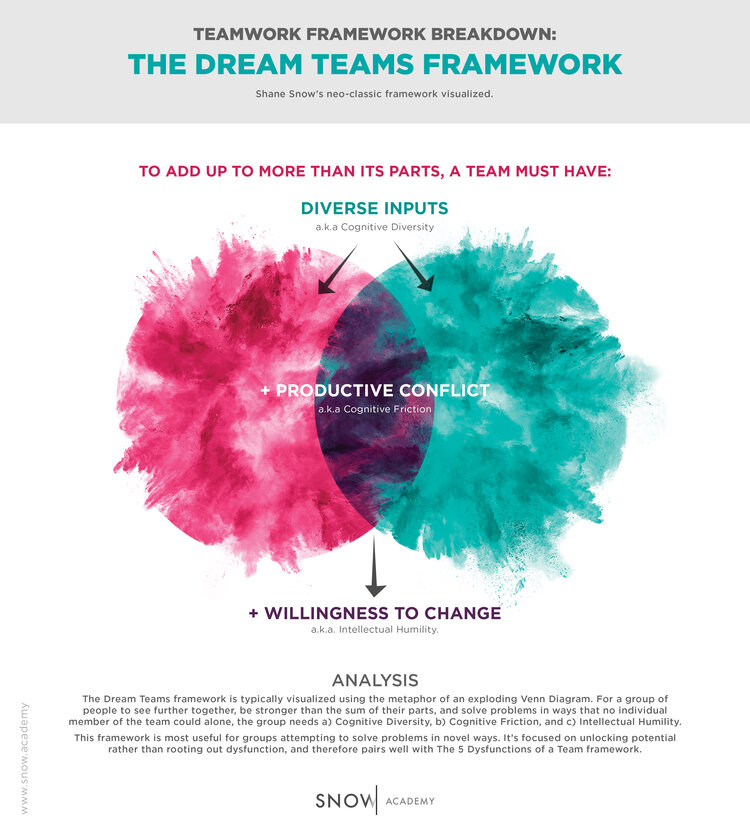
Photo source: https://shanesnow.com/research/a-short-guide-to-the-dream-team-leadership-framework
Cognitive Diversity: Mix Minds, Make Magic
If everyone thinks the same, your team is dead in the water. Breakthroughs come from cognitive diversity; a collision of different perspectives, mental models, and problem-solving approaches. Forget “culture fit”; you want culture add. Bring in the strategist who sees patterns in chaos, the rebel who questions everything, and the quiet observer who notices what everyone else misses. The rule: reward progress, not just correctness. Celebrate the bold ideas that push the team forward, even if they’re messy at first. The more mental ingredients in your mix, the bigger the recipe for innovation.
Cognitive Friction: Clash to Create
Diverse thinking is useless if it sits politely in the corner. High-performing teams fight productively. This is cognitive friction: smashing ideas together until sparks fly. Debate to explore, not to “win.” Seek out wild ideas that feel uncomfortable. Invite dissent, applaud pushback, and use humor and play to keep the clash from turning personal. The magic happens when tension turns into insight. If your team can’t argue well, it can’t innovate.
Intellectual Humility: Check Your Ego at the Door
All the diversity and debate in the world is worthless without intellectual humility. Dream Teams are filled with people who can say: “I might be wrong. Teach me.” They listen first, judge later. They separate ideas from ego, and they can pivot when new evidence lands on the table. Empathy and curiosity are the ultimate competitive edges. The teams that win are the ones that adapt, evolve, and change their minds faster than the competition.
Final Word: Stop Settling for Default Teams
So no, you don’t have to work with just anyone. In fact, you shouldn’t. Building a team is like mixing a cocktail, get the wrong ingredients, and it’s flat; get the right balance, and it’s electric.
Don’t settle for default. Curate your Dream Team.
And while you’re at it, turn the spotlight on yourself. These three principles aren’t just for “teams”—they’re for you.
- Cognitive Diversity? When’s the last time you spent time with someone whose values or mindset clash with yours, just to stretch your brain?
- Intellectual Humility? I’ve had to learn that different doesn’t mean wrong. A challenge to my idea isn’t a personal attack, it’s an invitation to see the world from a new angle.
- Cognitive Friction? I used to swallow disagreement because I didn’t want to rock the boat. Now? I say, “I don’t see it that way,” and watch ideas sharpen. If it’s the right team, your pushback isn’t a problem, it’s the secret ingredient.
Bottom line: teamwork doesn’t make the dream work.
Dream teams do.